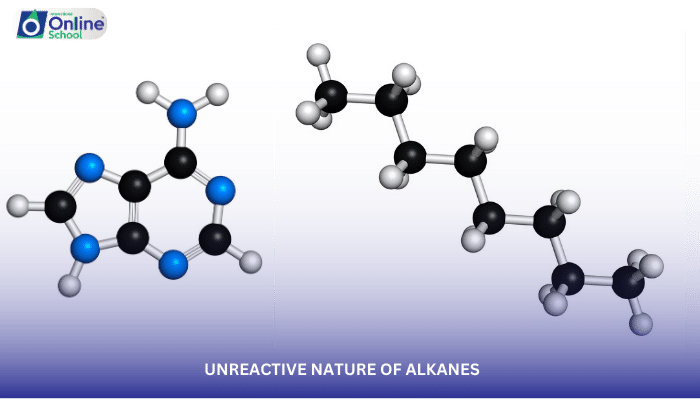
Learning Outcomes:
i. Explain the concept of bond strength and its relationship to reactivity.
ii. Analyze the factors contributing to the unreactive nature of alkanes.
iii. Describe the inertness of alkanes towards polar reagents, such as acids, bases, and oxidizing agents.
iv. Identify exceptions to the general unreactivity of alkanes, such as combustion and halogenation under specific conditions.
v. Appreciate the significance of the unreactive nature of alkanes in various applications.
Introduction:
Alkanes, the simplest and most abundant hydrocarbons, are known for their remarkable resistance to chemical reactions. This unreactive nature, often referred to as inertness, is a defining characteristic of alkanes and has significant implications for their behavior in various chemical environments.
i. Bond Strength and Reactivity:
The reactivity of a compound is closely linked to the strength of its bonds. Stronger bonds require more energy to break, making the compound less reactive. Alkanes possess strong carbon-carbon (C-C) and carbon-hydrogen (C-H) bonds due to the overlap of hybridized orbitals. These strong bonds contribute to the overall unreactivity of alkanes.
ii. Factors Contributing to Alkanes' Unreactivity:
Several factors contribute to the unreactive nature of alkanes:
Saturated Hydrocarbons: Alkanes are saturated hydrocarbons, meaning all carbon atoms are bonded to the maximum number of hydrogen atoms. This saturation limits the possibility of adding additional groups or forming new bonds.
Symmetrical Electron Distribution: Alkanes have a symmetrical electron distribution, resulting in low polarizability and resistance to attack by polar reagents.
High Bond Dissociation Energies: The carbon-carbon and carbon-hydrogen bonds in alkanes have high bond dissociation energies, requiring significant energy input to break them and initiate reactions.
iii. Inertness towards Polar Reagents:
Alkanes generally exhibit inertness towards a wide range of polar reagents, including:
Acids: Alkanes do not react with acids due to the absence of reactive functional groups.
Bases: Alkanes are resistant to attack by bases due to their neutral nature.
Oxidizing Agents: Alkanes are generally unreactive towards oxidizing agents under normal conditions.
iv. Exceptions to Alkanes' Unreactivity:
While alkanes are typically unreactive, there are a few exceptions to this general rule:
Combustion: Alkanes undergo combustion, a reaction with oxygen, to produce carbon dioxide and water.
Halogenation: Under specific conditions, alkanes can undergo halogenation reactions, particularly with chlorine or bromine, to form halogenated alkanes.
v. Significance of Alkanes' Unreactivity:
The unreactive nature of alkanes has significant implications for their applications:
Fuels: Alkanes, particularly methane, propane, and butane, serve as valuable fuels due to their high energy content and relatively clean combustion.
Lubricants: Alkanes with longer chains, such as oils and waxes, are used as lubricants due to their ability to reduce friction between surfaces.
Insulators: Alkanes, with their strong bonds and symmetrical electron distribution, are good insulators, making them suitable for electrical applications.
The unreactive nature of alkanes, a result of strong bonds, saturated structure, and symmetrical electron distribution, makes them versatile and valuable compounds in various applications. Understanding the factors contributing to alkanes' inertness allows chemists to predict their behavior in chemical reactions and utilize their unique properties in various fields.
